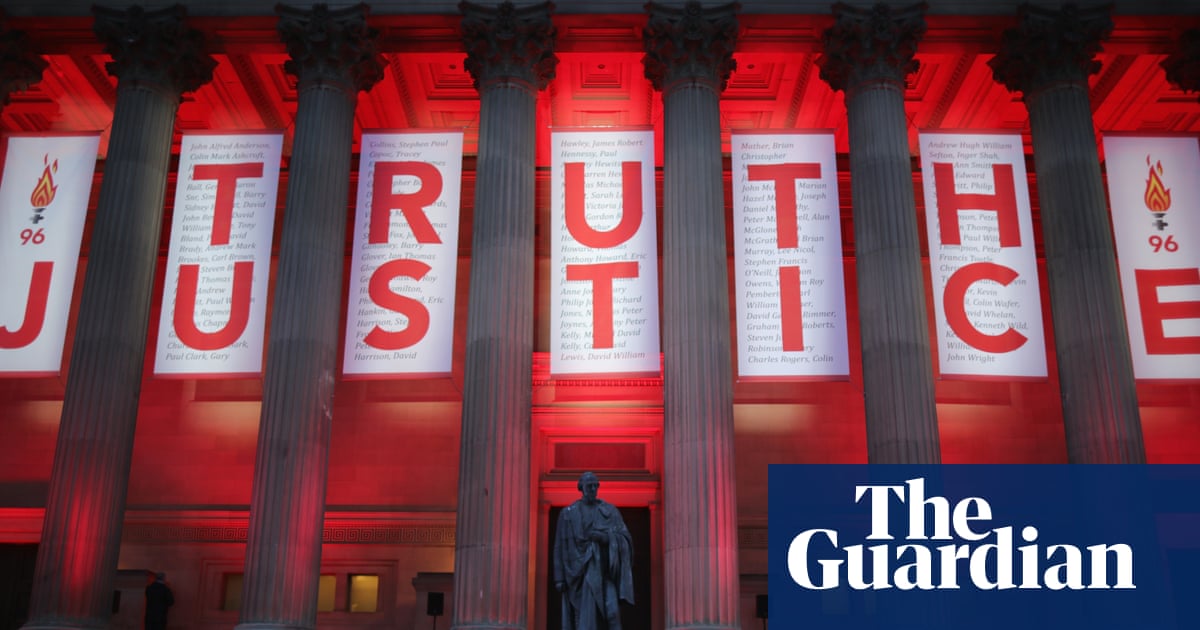
Good morning. We think we know this story, the one about the 97 who went to watch a football match on a sunny afternoon. Perhaps you remember, as I do, watching footage of the lethal crush at Sheffield Wednesday’s Hillsborough stadium, on the evening news in your childhood living room. Or maybe you read later how South Yorkshire police presented a series of false narratives that blamed Liverpool football club supporters, rather than take responsibility for their own catastrophic mismanagement of the FA Cup semi-final.
Today, after a decade of campaigning, a new law criminalising public bodies and officials that lie to the British public, and supporting people fighting these authorities for the truth, is expected to complete it final stages in the Commons, pushed through by Keir Starmer as one of his final acts as prime minister.
But why did a law championed by Labour since its time in opposition almost fail? I spoke to David Conn, who has been reporting on Hillsborough for 30 years, about the families’ final battle. First, the headlines.
UK news | British counter-terrorism police are now leading the investigation into the death of Ann Widdecombe in a shock development that has renewed the debate over the security of politicians. A 28-year-old man from Rotherham is being held in custody on suspicion of her murder.
Middle East | The US has launched its third consecutive night of strikes on Iran hours after Donald Trump said Washington would reinstate a maritime blockade on the country and, in an apparently policy reversal, charge ships for safe passage.
UK politics | Andy Burnham is to become Britain’s next prime minister after winning the backing of 349 Labour MPs, including all eligible members of Keir Starmer’s current cabinet, making it impossible for any rival to secure enough nominations to challenge him.
Environment | Most of the UK media stories about the record-breaking heatwave that struck in June failed to mention the climate crisis, analysis has found. Even fewer pieces drew a link between the heatwave and government policies designed to tackle the climate crisis.
US news | The US government has already paid back tens of billions of dollars in tariffs it collected before the supreme court ruled them illegal, according to budget figures released on Monday.
In 2016, the conclusions of the second inquest into the Hillsborough deaths at last fully vindicated the families. A jury found that those who died were unlawfully killed due to gross negligence manslaughter by match commander chief superintendent David Duckenfield and that no behaviour by Liverpool supporters contributed to the disaster. The 97th victim, Andrew Devine, died in 2021 of injuries sustained in the crush. (Later, Duckenfield was found not guilty of gross negligence manslaughter, one of a number of unsuccessful individual criminal prosecutions.)
“Immediately after, the families adopted the Hillsborough law as their positive legacy from the ordeal they had suffered,” David explains. “They wanted a duty of candour for public officials and authorities to be introduced and equality of funding for legal representation for people fighting for justice like them.” At the first inquest, families received no public funding for legal representation, while senior police officers and other public bodies had state-funded legal teams.
A law in this vein was first proposed as a private member’s bill by stalwart advocate of the cause Andy Burnham in 2017, when he was a Labour MP, but languished during the Tory administration. When Labour was elected in 2024, expectations were high: the Hillsborough law was a defining manifesto commitment and Keir Starmer was evidently intent on taking ownership of the reforms, which he announced at two party conferences and personally introduced in the Commons.
But by last winter, progress was mired in a bitter and intractable row about how the new law would apply to the security services. The government pulled the bill midway into its passage through parliament, prompting fury from the Hillsborough families.
“It was an extraordinary situation,” says David. “This has always been a Labour cause. They promised to introduce the law: Margaret Aspinal, whose 18-year-old son James died at Hillsborough, made a speech at conference to introduce Starmer. And yet somehow theywere arguing with the families and trying to carve out an exemption for the security services that had only recently been criticised in the Manchester Arena inquiry.”
Taking on the security services
The proposed law means those in public office have a positive duty to assist public inquiries with candour, and those who lie or evade will face prosecution. After concerted briefing from the security services, the government agreed to give security chiefs the final say over what evidence would be put forward to an inquiry. Campaigners were vehemently opposed, arguing this undermined the central purpose of the law by allowing some parts of the state to continue avoiding scrutiny.
David raises the peculiar dissonance between Labour’s promise to introduce the Hillsborough law and action. “It was so odd that this bill had been drafted in 2017, yet when the Labour government came in the law was facing all this resistance.”
But despite patronising briefings suggesting the families were “naive”, or ignorant of national security considerations, a concrete contemporary example bolstered their argument. “At the Manchester Arena inquiry, MI5 was found to have submitted an inaccurate account of intelligence it had relating to the perpetrator of the atrocity,” David says. “The inquiry chair found ultimately that the failure of MI5 to act swiftly on crucial intelligence was a ‘significant missed opportunity’ to take action that might have prevented the Manchester Arena attack in 2017. The Manchester Arena families are part of the coalition with the Hillsborough families , and the campaign has absolutely insisted that the security services had to be included in the law.”
Burnham’s role and Starmer’s legacy
With parliamentary business plans updated late last week to include the bill’s remaining Commons stages today, it is understood that the final sticking point – that any decisions on excluding evidence on the grounds of national security are for an inquiry chair to make- have been resolved to the families’ satisfaction. “This has finally been agreed in Starmer’s final week, it also clearly appears significant that Burnham, the Hillsborough families’ long-term supporter, is about to become prime minister.” Many of the profiles of the incoming prime minister churned out in recent weeks have highlighted the moment Burnham’s speech at the 20th-anniversary memorial service at Anfield in April 2009 was drowned out by chants of “justice for the 96”. “But I don’t think the reporting has fully taken into account how effective he was after that,” says David.
Burnham’s subsequent call for the disclosure of all related documents led to the establishment of the Hillsborough Independent Panel. Its 2012 report exposed the extent of police efforts to falsely blame Liverpool supporters for the disaster, and ultimately led to the quashing of the first inquest’s verdict of accidental death in December of that year. David links this commitment to those campaigning without redress for decades to Burnham’s later work on the infected blood scandal, as well as supporting calls for an inquiry into the policing by the South Yorkshire force (them again) at Orgreave during the miners’ strike.
Given the debate about whether Burnham is a good-vibes-only candidate, it’s worth registering that he brings a shovel when there’s spade work to be done. And that in his book Head North, Burnham describes how the “trigger” for making that public call for Hillsborough disclosure was reading a Guardian article at his kitchen table three days before the service, in which David reported families’ outrage that junior officers’ statements had been amended by their superiors to remove criticisms of the police.
A victory for solidarity
From his first meetings with the Hillsborough families back in the mid-90s, David has always been struck by their empathy for all those suffering injustice.
That solidarity was very much in evidence in this final battle: “The Hillsborough Law Now campaign is a genuine coalition, with families bereaved by the Manchester Arena atrocity, Grenfell fire, Covid. It’s a really strong alliance, and they were never going to give in because they didn’t accept they were putting national security at risk. This law is about the authorities learning from mistakes”.
David, whose diligent and passionate reporting over the decades many will be familiar with, asks us to take this moment “to understand the scale of this victory” – not least on behalf of those bereaved family members who have died in the intervening years.
“These families have always been underestimated. If you think about where they were after 1989: they suffered not just losing their loved ones in the most terrible circumstances but this disgraceful, toxic narrative from South Yorkshire police and a judicial system that failed to establish the truth for decades. And now they have succeeded so completely as to make it illegal for public officials to ever be less than candid about how a disaster occurred.”
I was moved by this letter from a wheelchair user in Westminster about badly parked ebikes that block their way. For disabled people, they’re making some streets unlivable. Hettie
This thoughtful piece from Australian oncologist Ranjana Srivastava examines why we shouldn’t shield youngsters from the realities of ageing and death. Libby
The actor Sam Neill, who has died at 78, was best known for his roles in Jurassic Park and The Piano. In his final interview, he spoke to the Guardian about reacting to puppets on screen, and the clumsy behaviour of his costar, the T rex. Hettie
France | The France midfielder Warren Zaïre-Emery says his team want to exact revenge on Spain and banish painful memories of their exit in the Euro 2024 semi-final, as the two sides meet again on Tuesday in search of a place in the World Cup final.
Argentina | Nick Ames has written a deep dive into England opponent in the other semi-final tomorrow night. The defending champions, who have a dramatic path to the final four, have a suspect right flank and can be bullied – but watch out for their No 10, who is apparently quite good.
Our morning email breaks down the key stories of the day, telling you what’s happening and why it matters
Pubs | Meanwhile, Matthew Weaver meets England’s struggling pub owners preparing for a much-needed bumper night on Wednesday. “I think our sales will treble,” says one, “especially as we’ve got Argentina – there’s so much rivalry and it could be payback for the Hand of God.”
Cricket | India defeated England by 270 runs in the one-off Test, a famous victory that will go some way to making up for their failure to reach the semi-finals of the T20 World Cup this month.
Football | Keir Starmer is expected to use his final week in office to push the Hillsborough law through its remaining stages in the Commons after months of delays. This bill aims to strengthen support for families seeking justice after major disasters and create new offences for officials who deliberately mislead the public or seek to block accountability.
Tennis | The creation of a joint commercial venture between the tours of the men’s Association of Tennis Professionals and the Women’s Tennis Association has been put on hold indefinitely as the women’s game faces the prospect of making significant cuts to its operational budget.
“Widdecombe death inquiry being treated as terror case”, is the Guardian’s front page today. The Times has “Widdecombe murder case taken over by terror police”, the Telegraph says “Police under fire over Widdecombe terror probe”, the Express’s headline is “Terror cops now leading Ann death probe” and the Mirror goes with “Terror probe”. Metro says “Ann murder now treated as terrorism”.
The i Paper runs with “Farage declined taxpayer-funded security – calling offer ‘inadequate’”. Lastly, the FT has “Dubai’s DP World planning new east coast port to bypass Hormuz strait”.
Ann Widdecombe murder investigation taken over by counter-terror police
Counter-terrorism police are now leading the investigation into the death of the former MP and Reform UK spokesperson Ann Widdecombe, in light of “new information and evidence”.
A 28-year-old white British man from Rotherham, South Yorkshire, was arrested on suspicion of murder on Saturday. Lucy Hough speaks to the Guardian’s head of national news, Archie Bland.
A bit of good news to remind you that the world’s not all bad
Chatsworth House in Derbyshire, which is supposed to have served as the inspiration for Jane Austen’s Pemberley in Pride and Prejudice, is home to a renowned private art collection, including rare first editions by authors such as Charlotte Brontë and Oscar Wilde.
But the cost of admission to the house (£33 for an adult, rising to £40 at Christmas), has long put its heritage out of reach for many. Now, Chatsworth is pioneering a scheme of free community memberships that people can borrow from Derbyshire libraries. It hopes the pass could become a model for widening access to heritage across Britain.
“For me, the best bit was walking around places that you recognise from TV and film adaptations,” said Kate, a contract worker who lives locally and was one of the first people to benefit from the scheme. “I felt like I’d been there before.”
And finally, the Guardian’s puzzles are here to keep you entertained throughout the day. Until tomorrow.